Woonsocket, Rhode Island is a compact, historically rich city in the Blackstone Valley a community where residential neighborhoods, commercial corridors, and light industrial zones sit side by side along the Blackstone River. Like much of New England, Woonsocket experiences the full spectrum of seasonal conditions: cold, snowy winters with repeated freeze-thaw cycles, wet springs, warm summers, and variable falls. This climate is among the most demanding in North America for paved surfaces, and it is one of the primary reasons that professional Paving Contractor Woonsocket play an essential role in maintaining and improving properties throughout the city and surrounding Providence County communities.
What a Paving Contractor Does
A paving contractor specializes in the installation, repair, and maintenance of paved surfaces primarily asphalt, though some contractors also work with concrete, pavers, and other surface materials. The scope of work covers residential driveways, commercial parking lots, private roads, municipal infrastructure, walkways, and any other ground-level surface that requires a durable, functional paving solution. In a city like Woonsocket, where the combination of dense residential neighborhoods and active commercial activity creates consistent demand for both new paving and maintenance services, experienced paving contractors are integral to the built environment.
The full range of paving contractor services typically includes new installation preparing the subbase, grading, and laying new asphalt; resurfacing applying a fresh layer of asphalt over an existing surface that has deteriorated; repair work patching potholes, crack filling, and correcting specific surface failures; sealcoating applying a protective coating over existing asphalt to extend its lifespan; and striping applying traffic markings and parking space lines on commercial lots. Each of these services requires different equipment, materials, and expertise, and a well-equipped paving contractor serves clients across all of them.
Why New England’s Climate Makes Professional Paving Critical
Rhode Island’s climate subjects paved surfaces to some of the harshest conditions in the country. The freeze-thaw cycle is the primary mechanism of asphalt deterioration in Woonsocket and across northern Rhode Island. Water infiltrates existing cracks and micro-fissures in the asphalt surface. When temperatures drop below freezing which happens frequently from November through March in Woonsocket that water expands as it turns to ice, widening existing cracks and creating new ones. When temperatures rise and the ice melts, the water moves deeper into the pavement structure, weakening the base. Repeated freeze-thaw cycles over a single winter season can rapidly accelerate what began as minor surface cracking into significant structural damage.
Snow plowing adds mechanical stress to asphalt surfaces. Plow blades that catch the edges of deteriorated asphalt can tear away chunks of pavement, particularly at expansion joints and areas where cracking has already begun. The de-icing salts and chemicals applied to roads and driveways in Woonsocket winters accelerate the oxidation of asphalt binder, making the surface brittle and more susceptible to cracking over time. Professional paving contractors who work in northern Rhode Island understand these mechanisms and incorporate them into their material selection, subbase preparation, and maintenance recommendations.
Summer heat presents a different challenge. Asphalt is a petroleum-based material that softens at high temperatures. During Woonsocket’s hottest summer months, heavy vehicles parked on asphalt can create ruts and depressions, particularly in areas where the pavement is older or the sub-base was not adequately prepared. Proper asphalt mix design selecting a mix with appropriate polymer content and aggregate gradation for the expected temperature and traffic loading is part of what distinguishes professional paving from substandard work.
The Paving Process in Woonsocket
Professional asphalt paving in Woonsocket follows a consistent sequence regardless of whether the project is a residential driveway or a commercial parking lot. The process begins with site assessment evaluating the existing surface condition, the underlying subbase, drainage patterns, and the scope of work needed. For new installations on raw ground, this includes evaluating the soil bearing capacity and determining the appropriate depth of gravel subbase. For resurfacing projects, it includes assessing whether the existing pavement is suitable for overlay or whether it must be removed.
Subbase preparation is the foundational step that determines long-term performance. In Woonsocket’s clay and loam soils typical of the Blackstone Valley proper subbase preparation means establishing a well-graded, adequately thick gravel base that distributes traffic loads and provides drainage beneath the asphalt. Asphalt that is paved over a poorly prepared or inadequate subbase will fail prematurely regardless of how well the asphalt itself is placed. This is one of the most important distinctions between quality paving contractors and those who cut corners.
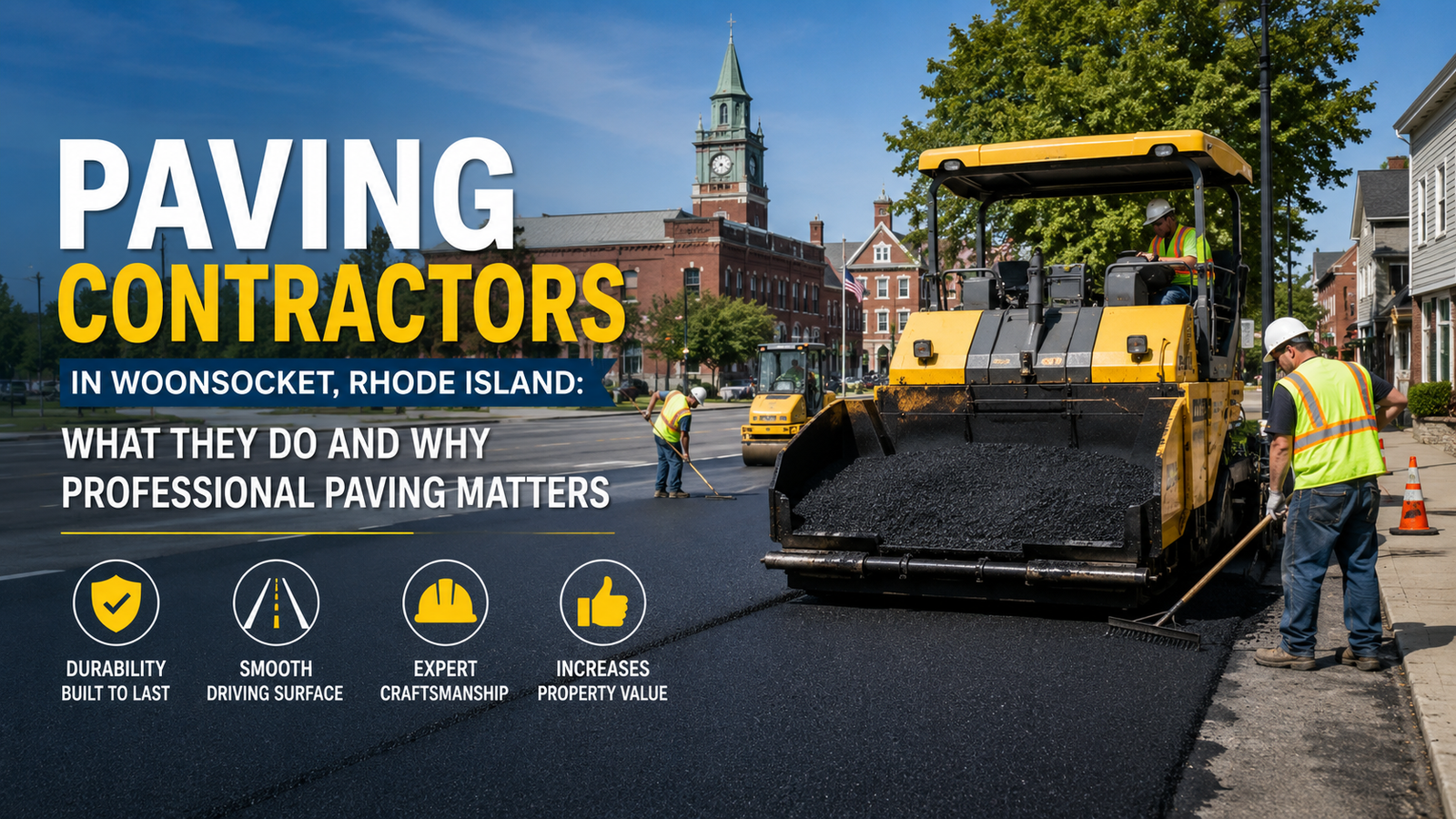
Asphalt installation follows subbase preparation. Hot mix asphalt delivered by truck from a paving plant at temperatures between 275 and 300 degrees Fahrenheit is laid using a paving machine that distributes the material at consistent depth and smooths it to the specified grade. Compaction with a roller follows immediately, while the asphalt is still hot enough to compact properly. The specific asphalt mix aggregate gradation, binder content, and any polymer additives is selected for the application type and expected traffic. Rhode Island’s Department of Transportation has established specific mix specifications for state roads that reflect the climate performance requirements; professional contractors apply similar thinking to private projects.
Residential and Commercial Paving in Woonsocket
The residential paving market in Woonsocket centers on driveways. Many of the city’s homes particularly in the older established neighborhoods built in the early to mid-20th century have driveways that are aging and in need of resurfacing or replacement. A professionally paved residential driveway in Woonsocket typically includes removal of the existing surface (if required), grading and subbase preparation, and installation of two to three inches of compacted asphalt in one or two lifts. Proper edge detail sloped or beveled asphalt edges rather than vertical cut edges improves durability and appearance.
Commercial paving in Woonsocket covers the parking lots, access roads, and paved areas of the city’s retail, industrial, and institutional properties. Commercial lots carry higher traffic volumes and heavier vehicle loads than residential driveways, which requires thicker asphalt sections, heavier-duty subbase preparation, and careful drainage design. Line striping, ADA-compliant accessible space marking, and traffic flow signage are part of the complete commercial paving scope.
Municipal paving repairing and resurfacing public roads and sidewalks represents the public-facing side of Woonsocket’s paving activity. Rhode Island’s extensive road maintenance programs, including the RhodeWorks infrastructure initiative, have established quality standards for road paving that professional contractors must meet, including core sampling and in-place density testing to verify that compaction meets specification.
Frequently Asked Questions About Paving Contractors in Woonsocket
How long does an asphalt driveway last in Rhode Island? A properly installed and maintained asphalt driveway in Woonsocket can last 20 to 30 years. Regular sealcoating every 3 to 5 years and prompt attention to cracks and surface damage extend the lifespan significantly.
What is the best time of year to pave in Woonsocket? Asphalt paving in Rhode Island is typically performed from late spring through early fall roughly May through October when air and ground temperatures are warm enough for proper asphalt compaction. Temperatures below about 50 degrees Fahrenheit make proper compaction difficult and reduce long-term performance.
Can asphalt be paved over an existing driveway? Yes, under the right conditions. If the existing asphalt is structurally sound not showing base failure, significant cracking, or serious drainage problems a new overlay of 1.5 to 2 inches of asphalt can provide a refreshed surface. If the base has failed, overlay is not appropriate and full removal and replacement is needed.